Showing posts sorted by relevance for query creek. Sort by date Show all posts

Thursday, May 29, 2025

La La Creek in Warburton Melbourne for Water H2O Thursday


The journey from Melbourne to La La Creek in Warburton is oftentimes a test of patience. Each township en route enforces a strict speed limit of 50 kilometres per hour, and the frequent deceleration through these settlements serves only to prolong the wearying passage. Yet, upon arrival, all such inconveniences are swiftly forgotten.

La La Creek, nestled within the tranquil folds of the Yarra Ranges, offers a quietude that soothes the spirit. In winter, the air is brisk and pure, and the perennial murmur of the creek weaves through the forested glen like a thread of silver sound. The absence of mosquitoes during the colder months renders the experience all the more agreeable, allowing one to linger undisturbed by the banks of this gentle watercourse.

Once a source of life and sustenance for the Wurundjeri people and later a site frequented by timber-cutters and bushwalkers alike, the creek now flows in peaceful retirement, its mossy stones and fern-fringed edges recalling a natural history both rich and enduring. Here, beneath towering mountain ash and alongside trails softened by fallen leaves, one finds a serenity rare in the modern world.

Sony A7RV

FE 20-70mm f4 G

Linking Water H2O Thursday


Thursday, November 6, 2025

Waixi Creek Taipei for Water H2O Thursday


Waixi Creek winds quietly through the misty hills of Pingxi, its water a shade of deep green that seems to hold the reflection of the forest itself. Upstream, I crossed a semi-abandoned bridge, its timbers darkened by age and softened by moss. The air was still, save for the low whisper of water and the faint creak of wood beneath my steps. Ahead, a small fan-shaped waterfall spilled gracefully over rocks, its delicate spread catching the morning light. I lingered there, letting the sound of the water wash over me, not yet in sight of the great Shifen Waterfall but already feeling its presence—somewhere ahead, where the creek gathers itself into strength.

Shifen Waterfall lies deep within the Pingxi Valley of northern Taiwan, where the Keelung River winds through layered stone and forest. The name “Shifen” dates back to the Qing dynasty, when ten families settled in this fertile gorge and divided the land into ten equal portions. Over the centuries, the river shaped the valley into what it is today: a landscape of cliffs, pools, and narrow ravines, where countless tributaries like Waixi feed into the main flow. The region’s bedrock slopes against the direction of the water, forcing it into a magnificent arc as it drops nearly twenty meters across a span of forty. When sunlight pierces the rising mist, a rainbow sometimes forms across the pool, and locals call it the “Rainbow Pond.”

The Shifen area once thrived as a coal-mining settlement during the Japanese colonial period. The Pingxi railway line was built through the valley to carry black coal to the port cities, and its narrow track still runs alongside the river today. Over time, as mining faded into memory, the valley’s rhythm returned to one of water and forest. The old bridges, tunnels, and stone paths remain, quietly reclaimed by moss and vines, linking the past to the present with every weathered beam and rusted nail.

As I followed Waixi upstream that morning, I felt that mixture of age and renewal in every sight—the rustic bridge standing like a remnant of an older world, the creek’s green current alive and changing, and the fan-shaped waterfall fanning out in a quiet gesture of welcome. The larger Shifen Waterfall waited farther down, roaring and majestic, but here in the upper stream there was a gentler beauty. It was a place of pause, where time moved as slowly as the drifting ripples on the water’s surface.

Walking toward the main falls, I realised that what draws one to Shifen is not only the grandeur of the waterfall itself, but the quiet journey toward it. The bridges, the green pools, the minor cascades—each holds a story, a small breath of history and nature intertwined. In that gentle space before the thunder of the falls, the world feels balanced between motion and stillness. The creek, the valley, and the waterfall together form a kind of living memory—Taiwan’s heart reflected in water, stone, and light.


Sony A7RV

FE 20-70mm f4 G


Linking Water H2O Thursday


Thursday, June 18, 2026

Wulai Creek in Taipei Taiwan for Water H2O Thursday


Wulai Creek was not always this emerald ribbon winding through the mountains. For years its waters bore the scars of pollution, dulled and burdened by neglect. Yet patient restoration slowly unveiled what had been hidden beneath. Today the creek glows with a luminous green, clear and refreshing, its surface catching fragments of the forest above. Reflections of overhanging foliage ripple across the water, blending leaf and stream into a single tapestry of living colour.

Meanwhile, Joel remains quite unwell, and we have already postponed his birthday dinner once. As the days pass, I find myself hoping more than anything that he recovers soon, so that the celebration can finally take place—not as a compromise, but as the joyful occasion it was always meant to be.


Sony A7RV

FE 20-70mm f4 G


Linking Water H2O Thursday

Sunday, March 1, 2026

Sailor's falls Daylesford for Sunday Best


Not far from Melbourne, in the old goldfields country near the village of Sailors Falls, lies Sailors Falls—a modest cascade tucked within a quiet fold of bushland. The journey down is as memorable as the water itself: a timber boardwalk, gently descending in patient tiers, leads visitors through stands of eucalyptus and wattle. The wood underfoot creaks softly, as though it remembers the boots of miners and the measured steps of those who came seeking fortune rather than scenery.

The falls take their name from Sailors Creek, a tributary that threads through this part of Victoria. In the 1850s, when gold fever gripped the colony, this valley stirred with restless ambition. Tents and rough-hewn huts once dotted the surrounding hills; pans clinked against stone; men traced the creek’s bends in hope of colour in the gravel. Daylesford itself rose from that era, its prosperity drawn from both gold and, later, the mineral springs that still define the region. Though the fever subsided, the landscape retained its layered memory—of extraction, of settlement, of gradual return to quiet.

Today, Sailors Falls belongs less to industry and more to contemplation. In winter and spring, rainfall gathers its resolve and sends water spilling over the basalt ledges in a pale, silken veil. Ferns flourish in the cool spray, and the creek speaks with a clear, unhurried voice. Yet summer in Victoria can be exacting. The same cascade that shimmered months before may dwindle to a faint trickle, or fall silent altogether, leaving behind darkened rock and the memory of motion. It is a gentle disappointment, perhaps, but also a reminder of the continent’s austere climate—of abundance and absence held in seasonal balance.

Even when the water retreats, the boardwalk still guides the way, and the valley keeps its composure. Sailors Falls does not overwhelm; it endures—an echo of gold-rush tumult, a refuge of timber and stone, and a small testament to how landscapes outlast the urgencies of those who pass through them.


Sony A7RV

FE 16-35mm f2.8 GM


Linking Sunday Best


Thursday, March 12, 2026

WuLai Creek, Taipei for Water H2O Thursday


Wulai Creek lies just beyond the bustle of Taipei, close enough that one can slip away for a moment of quiet without a long journey or a demanding hike. The water moves with a gentle insistence, its surface brushed with a faint green tint that seems borrowed from the surrounding hills.

Here, photography becomes an easy pleasure. A camera is lifted, the shutter held just long enough to soften the restless current. The exposure is brief—only a whisper of time—yet sufficient to coax the water into silky motion while preserving its lively flow.

It is a place where effort is minimal and reward immediate: the creek gliding past, light touching the water, and the simple satisfaction of capturing movement without ever straying far from the city.


Sony A7RV

FE 70-200mm f4 G


Linking Water H2O Thursday


Thursday, December 22, 2022

Creek in Gippsland, Victoria, Australia


Water can be so soothing. Xmas is truly a silly mad season. After a spiraling runs of various health issues affecting mum and me, my buddy is going through a crisis in marriage...

It is easier to sit by the creek away from the world


Sony A7RIV

FE 16-35mm f2.8 GM

Linking Wordless Wednesday


Thursday, August 2, 2012

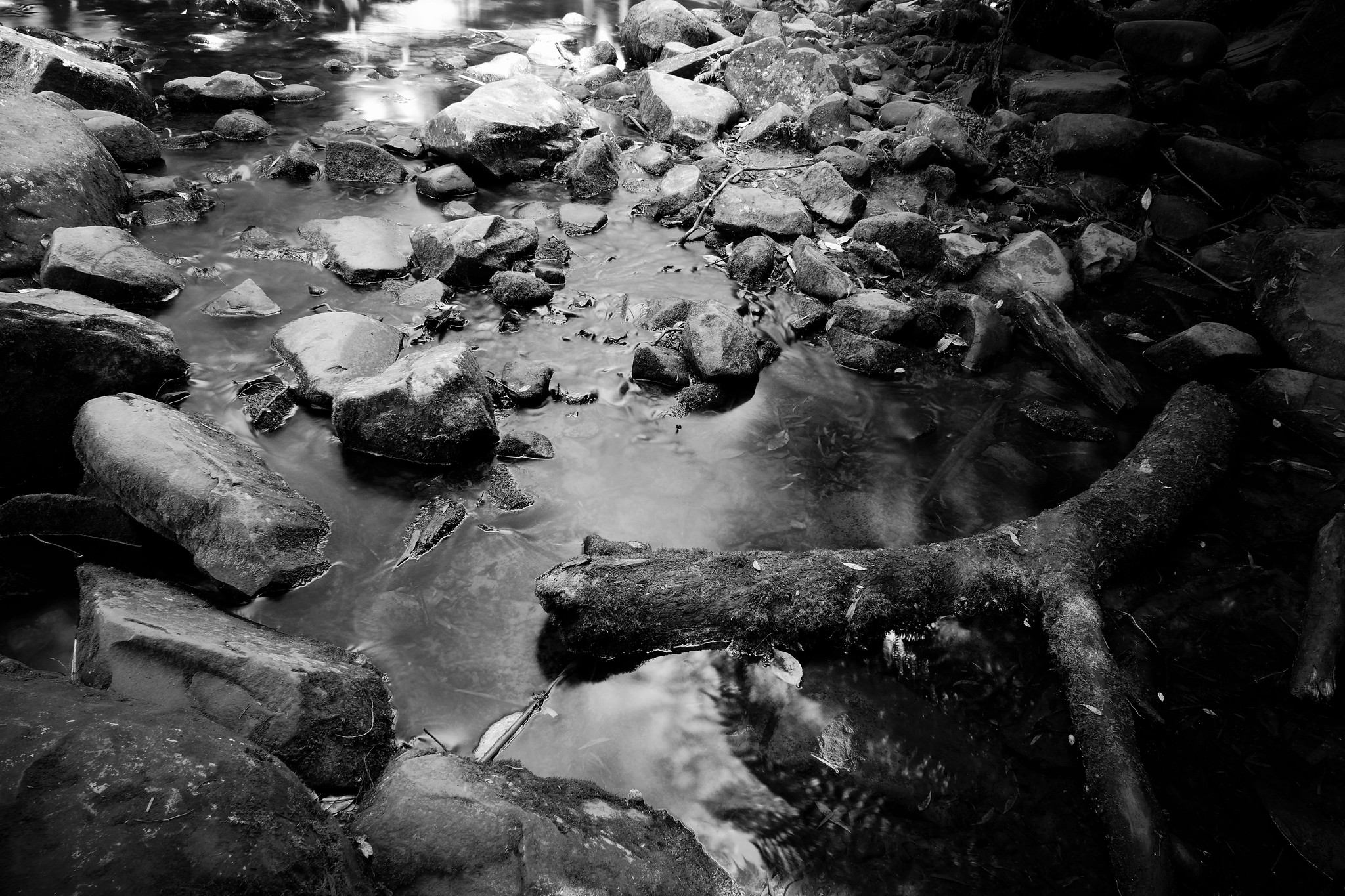
Creek with silky flow


From the recent post on over use of neutral density filters, this was another example of over use of 3 filters here. Funnily, the overuse of filters does contribute to severe vignetting. The correction of that rendered the photo a little unreal. Still, this image somewhat gave that air of inspiration and energy!!

The shot taken at Mt Baw Baw a while back. It was very dark, broodingly wet when I visited a random creek in the region. A shot out of curiosity turned out not so bad when I viewed some time later!

Taken by Pentax Da* 16-50mm f2.8 -> The zoom with dodgy reputation for hunting autofocus and bad quality control from Vietnam!

Saturday, May 30, 2026

Abandoned Holden Cars in Metcalfe Victoria for Black and white community


Metcalfe sits in a quiet fold of central Victoria, where the land loosens into low, weathered rises and dry gullies that remember older climates. It is not a town that announces itself; it accumulates—stone fences softened by lichen, stringybark and grey box eucalypts scattered in hesitant clusters, and paddocks that widen and narrow as if the earth itself cannot decide on straight lines.

This is country shaped by gold and forgetting. In the nineteenth century, prospectors moved through here on their way to richer strikes around Castlemaine and Daylesford, carving tracks that later became the faint grammar of today’s roads. Metcalfe never became a city of consequence; it became instead a relay point of aspiration—enough water in the Coliban River system to tempt settlement, enough soil for grazing, and enough timber to briefly feed the furnaces of early industry. When the gold faded, the population loosened its grip on the land, leaving behind a geography of partial occupation: farmhouses at distance, sheds leaning into wind, and long pauses between human signatures.

The hills around it are not dramatic so much as persistent. They roll with an understated patience, stitched together by dry stone walls and creek lines that only fully speak after rain. In summer, the heat compresses everything into a pale hush; in winter, mist settles in the gullies like an old memory refusing to leave.

And then there are the Holdens.

They appear in fragments rather than as objects of arrival—rusted shells half-swallowed by blackberries, utes resting in creek beds like exhausted animals, sedans stripped of glass and identity, their chrome reduced to dull punctuation. In Metcalfe and its surrounding backroads, these abandoned Australian icons seem less discarded than gently returned to the landscape. The Holden, once the emblem of postwar optimism and suburban expansion, here becomes something different: a study in entropy, in how national mythologies rust when left unattended.

There is an almost quiet obsession in the way they persist. Some sit for decades in the same angle of repose, bonnet slightly open as if mid-thought. Others are reduced to skeletal outlines—door frames, axle lines, the suggestion of a grille. Grass grows through floor pans; saplings root in back seats. In gullies, water occasionally reclaims them, polishing paint into mineral memory.

Locals and passersby speak of them indirectly, as if direct acknowledgment might disturb their slow transformation. They are landmarks of a kind, but not navigational ones—more like emotional markers of what remains when utility, pride, and ownership have all dissolved into the same rust-colored quiet.

So Metcalfe becomes a composite landscape: geological patience, colonial residue, agricultural pause, and automotive decay. A place where trees gather in small conspiratorial clusters, where roads taper into suggestion, and where even the most manufactured symbols of mobility eventually learn stillness.


Sony A7RV

FE 24mm f1.4 GM


Linking Black and white community

Monday, July 18, 2022

Warburton Creek


A bit Zen, right?

Love the tone in this place. In summer, this spot would be filled with fierce mosquitoes everywhere. 


Sony A7RIV 

FE 14mm f1.8 GM

This place is so dark I dont even need a neutral density filter


Creek


Tuesday, August 20, 2024

Arthur's Pass Creek in New Zealand for Treasure Tuesday


The hike to Devil's Bowl Falls follows a trail alongside the creek.

Sony A7RV

FE 20-70mm f4 G

Linking Treasure Tuesday


Thursday, August 31, 2023

Warburton Creek for Water H2O Thursday


Last Saturday was pretty much cloudy overcast. So picking a random creek in Warburton again.

Sony A7RV

FE 14mm f1.8 GM


Joel in the background for infrared test


Linking Water H2O Thursday


Monday, November 10, 2025

Wulai creek fruit mural, Taipei for Mural Monday


Last week, I wrote about the Wulai Creek region in Taipei. Recently, I came across a mural there depicting an assortment of fruits. The entire artwork has fallen into decay, its surface mottled with mould and weathered by time. Yet, in its deterioration, I found it hauntingly unique and strangely beautiful.


Sony A7RV

FE 20-70mm f4 G


Linking Mural Monday

Sunday, January 29, 2017

Creek at Lorne, Victoria, Australia


Black and White conversion for a creek beneath Erskine Falls

Saturday, July 16, 2022

Warburton Creek


Long exposure in this waterway turns out quite rewarding 


Sony A7RIV + FE 16-35mm f2.8 GM


Long Exposure shots


Sunday, August 10, 2025

Killen Falls Ballina NSW for Sunday Best


I have visited this waterfall on several occasions, primarily during my locum postings in either Ballina or Lismore, New South Wales. While I have previously shared several images of the falls, I had not, until now, revealed the singular perspective from within the cave behind the cascade. On that particular visit, the conditions were exceedingly damp, the air thick with mist and the roar of falling water echoing within the hollowed rock.

Killen Falls, part of the Emigrant Creek catchment, is a vestige of the region's ancient volcanic history—its basalt cliffs formed by lava flows from the long-extinct Mount Warning shield volcano. The waterfall plunges over a semi-circular basalt overhang, allowing one to stand within the cave and behold the curtain of water from behind, a rare and immersive vantage point in nature.

Following this wet and awe-filled exploration, I ventured to a nearby township where I partook in a traditional Jewish breakfast—an experience that remains warmly entwined with the memory of that elemental and storied place.


Sony A7RV

FE 20-70mm f4 G


Linking Sunday Best


Sunday, September 3, 2023

Warburton creek river flow for Sunday Best


I lost my 50mm f1.2 . I bought the lens again for its special rendition it has. 


Sony A7RV 

FE 50mm f1.2 


Linking Sunday Best


Tuesday, August 16, 2022

The cascade, Metcalfe, Victoria


Normally this creek is dried out completely. When it fills up, it is nice to do a long exposure


Sony A7RIV

FE 16-35mm f2.8 GM

Sony A7RIV shots


Thursday, April 9, 2026

Serenity falls Sunshine Coast for Water H2O Thursday


Serenity Falls lay hidden like a secret whispered between the trees, deep within the folds of South East Queensland. Joel and I arrived not so much as visitors, but as seekers—drawn by the quiet promise of water, stone, and light. We wandered until our legs ached and our breaths grew shallow, chasing every sunlit corner that seemed worthy of memory, every fleeting composition that begged to be held still.

The forest seemed endless that day, each turn revealing another scene more delicate than the last—ferns trembling in filtered light, water slipping over rock as though time itself had softened. We were exhaustive, relentless in our pursuit of beauty, as though the landscape might vanish if we failed to notice it fully.

And yet, there was this one frame—this single, suspended moment—that I kept for myself. Perhaps because it held something quieter, something less performative. Not made for the passing scroll, but for remembrance. Serenity Falls, in that instant, was not just a place we explored—it was something we almost understood, but never quite captured.


Informative Overview

Serenity Falls is a lesser-known but visually striking waterfall located within the Springbrook National Park in South East Queensland. The park itself forms part of the ancient Gondwana Rainforests, a UNESCO World Heritage-listed system known for its exceptional biodiversity and geological history.

Location and Access

Serenity Falls sits within the Springbrook plateau region, inland from the Gold Coast. While not as prominently signposted as major attractions like Purling Brook Falls or Natural Bridge, it is typically accessed via walking tracks branching from established circuits such as the Twin Falls Circuit or Warringa Pool Track. These trails range from moderate to occasionally strenuous, with uneven terrain, stairs, and sections that can become slippery after rain.

Geological Formation

The waterfall is part of the eroded remnants of the Tweed Volcano, one of the largest shield volcanoes in the Southern Hemisphere, active around 23 million years ago. Over millennia, watercourses carved through layers of basalt and rhyolite, creating steep escarpments and narrow घाट-like valleys. Serenity Falls exemplifies this process, cascading over rock ledges shaped by differential erosion.

Hydrology and Seasonal Variation

Like many waterfalls in the region, Serenity Falls is highly dependent on rainfall. During the wet season (typically November to March), the falls can become powerful and dramatic, with increased flow and mist formation. In drier months, the cascade may reduce to a gentler trickle, revealing more of the underlying rock structure and allowing closer inspection of the geological layers.

Ecology

The surrounding environment is characterised by subtropical rainforest, including species such as:

  • Antarctic beech remnants in cooler pockets
  • Hoop pine and brush box trees
  • Dense understories of ferns, vines, and mosses

The area supports diverse fauna, including:

  • Eastern water dragons near creek lines
  • Various frog species, particularly active after rainfall
  • Birdlife such as the Albert’s lyrebird and whipbirds

The microclimate around the falls—cool, humid, and shaded—supports specialised plant communities, including lichens and moisture-dependent epiphytes.

Cultural and Recreational Context

Springbrook National Park is part of the traditional lands of the Yugambeh people, who maintain deep cultural connections to the landscape. While Serenity Falls itself is less formally interpreted, the broader region holds significance in Indigenous heritage and storytelling.

From a recreational perspective, the falls appeal to:

  • Photographers seeking less crowded compositions
  • Hikers interested in quieter trails
  • Visitors looking for immersive, less commercialised natural settings

However, access requires caution:

  • Tracks can be steep and poorly marked in sections
  • Weather conditions can change rapidly
  • Swimming, if attempted, should be approached carefully due to submerged hazards and variable water depth


Sony A7RV

FE 20-70mm f4 G


Linking Water H2O Thursday


Thursday, June 11, 2026

Sailor's Falls Daylesford for Water H2O Thursday


Sailors Falls has always seemed to mirror the fortunes of Daylesford itself. In winter and after good rains, the water tumbles gracefully through the basalt gorge, a reminder of the volcanic forces that shaped this corner of Victoria thousands of years ago. Yet in recent years I have often found the falls reduced to little more than a damp rock face, the creek surrendering to drought and changing seasons. Even so, I still find myself returning. Some places earn a permanent place in our personal geography, regardless of what time and circumstance have done to them.

Daylesford was once one of those places for me. Born from the gold rushes of the 1850s and later reinvented through its mineral springs, the town carried a character all its own. It felt eccentric in the best possible way. The streets were filled with artists, potters, glassmakers and dreamers who seemed delightfully indifferent to fashion. Their workshops were full of oddities and beauty, and over the years I brought home many treasured pieces of glass art and pottery from people whose quirks were as memorable as their creations.

My connection to the town was not only as a visitor. For many years I serviced two nursing homes there, becoming familiar with the rhythms of the community beyond the cafés and galleries. Back then Daylesford felt welcoming, a refuge for a weekend escape from Bendigo. Today I rarely linger. The nursing homes have long since passed into the hands of large Melbourne-based operators, and much of the town seems transformed by success and popularity. Whether fairly or not, I now sense a distance from visitors that was never there before.

One place that remains tied to happier memories is the renowned Lake House Restaurant. I shared memorable meals there with a small circle of photographer friends, conversations stretching long into the evening over good food and wine. Time, however, has its way with all gatherings. Most of that circle has drifted away, and now only Joel remains.

Lately I find myself thinking about him often. He seems to be facing one health problem after another, and I worry about what lies ahead. As the years pass, meaningful friendships become rarer and more precious. They are no longer casual companions for passing moments but something closer to a safe harbour — a private refuge where one can speak honestly and be understood without explanation.

Perhaps that is why I continue to visit Sailors Falls. The water may disappear, the town may change, and familiar faces may fade from the landscape, but certain places hold the memories of who we were and the people who travelled beside us. Even when the falls run dry, they still carry something worth returning for.

Sony A7RV

FE 16-35mm f2.8 GM


Linking Water H2O Thursday


Friday, February 20, 2026

Goornong Sunrise for Sky watch Friday


In earlier years I drove long arterial roads into the rural margins of Victoria, the boot packed with files and instruments, the morning still undecided between frost and light. The work took me through paddocks silvered with dew and towns that woke slowly, bakeries first, then fuel stations, then the school crossings. I learned the discipline of dawn: how it breaks differently over stubble than over pasture, how mist lifts from creek flats in long, patient veils.

On the run north from Bendigo toward the Murray, the highway passes through Goornong—a small settlement set amid broadacre farming country. Its name is commonly traced to an Aboriginal word, often said to refer to mallee fowl, a reminder that this was once a landscape of woodland and grass before wheat and sheep laid their geometry across it. The district gathered itself in the late nineteenth century, when selectors and railway lines stitched the interior to markets; the railway’s arrival in the 1870s helped turn a scattering of holdings into a town with a school, a hall, and the steady rhythms of agricultural life.

By the time I was passing through for clinics, Goornong kept its quiet competence. Silos stood like sentinels against a wide sky. Fences ran straight as ruled lines. In summer the fields browned to parchment; in winter they breathed green again. And always, on the eastbound stretches, the sun would lift without apology—low, fierce, and perfectly aligned with the windscreen. It poured into the car in molten bands, turning the bitumen into a river of light and forcing me to squint behind the visor.

Those drives became a kind of liturgy. The glare was inconvenient, yes, but it was also exacting and honest—an unfiltered sunrise over country that has endured cycles of cultivation and drought, rail and road, departure and return. In that brief corridor between Bendigo and Echuca, the day announced itself without ornament, and I carried its brightness with me into the clinic rooms.

Sony A7RV

FE 70-200mm f2.8 GM


Linking Skywatch Friday