Showing posts sorted by relevance for query city. Sort by date Show all posts

Tuesday, January 6, 2026

Sydney Harbour Bridge at night for Treasure Tuesday


On my most recent journey to Sydney, I found myself once more compelled to photograph the city by night. As ever, the train bore me across the city to the bridge, that great span from which Sydney reveals itself most eloquently after dark. Yet the experience proved unlike my previous visits; the familiar scene appeared altered, as though the city had chosen to show me a different aspect of its character, quieter and more reflective, yet no less commanding.

The bridge itself, the Sydney Harbour Bridge, stands as one of the defining works of Australian engineering and civic ambition. Conceived in the early years of the twentieth century, it was born of a pressing need to unite the northern and southern shores of the harbour, which until then were linked only by ferry. Designed by Dr John Bradfield, whose vision shaped much of Sydney’s modern infrastructure, the bridge took form under the engineering firm Dorman Long and Company of Middlesbrough, England. Construction began in 1923 and employed thousands during the difficult years of the Great Depression, becoming both a source of livelihood and a symbol of national resolve.

Completed and opened in 1932, the bridge is the world’s largest steel arch bridge of its kind, its vast curve rising with austere grace above the harbour waters. Built from more than 52,000 tonnes of steel and held together by millions of rivets, it was assembled from both shores toward the centre, the two halves meeting with remarkable precision high above the water. Its opening was marked by ceremony and controversy alike, famously interrupted when a ribbon was cut prematurely in political protest, an episode now woven into the bridge’s lore.

Since that day, the Harbour Bridge has carried trains, vehicles, cyclists, and pedestrians, serving not merely as a crossing but as a constant presence in the life of the city. By night, when its arch is traced in light and reflected upon the dark water below, it appears less a feat of industry than a great, luminous gesture—binding shore to shore, past to present, and the restless city to its enduring harbour.


Sony A7RV

FE 20-70mm f4 G


Linking Treasure Tuesday


Tuesday, February 10, 2026

Safety Beach Melbourne for Treasure Tuesday


Joel’s son marked his birthday over the past weekend, and amid the quiet margins of that family celebration I set out alone for a brief drive toward the city’s shoreline, drawn by the promise of sunset and the reflective stillness that accompanies the day’s last light. The roads gradually widened and flattened as they approached the coast, the air acquiring that faint mineral scent of salt and seaweed long before the water itself came into view. It was a small pilgrimage — not merely to witness a sunset, but to stand in a place where the rhythms of the city yield to the older, more patient cadence of the ocean.

City beaches in Australia carry layered histories that extend far beyond their modern role as recreational landscapes. Long before promenades, car parks, and lifeguard towers appeared, these shores were gathering grounds for Indigenous communities whose connection to the coastline was ecological, cultural, and spiritual. The intertidal zones provided shellfish and fish; dunes sheltered native grasses and birdlife; tidal pools became quiet classrooms of observation and respect for the living sea. With European settlement came a gradual transformation: jetties constructed for trade, bathing pavilions erected in the late nineteenth and early twentieth centuries as seaside leisure became fashionable, and eventually surf lifesaving clubs — uniquely Australian institutions — formed to patrol waters that were both alluring and unforgiving.

As I arrived, the tide was easing outward, exposing stretches of wet sand that mirrored the sky like darkened glass. The urban skyline behind me seemed to dissolve into silhouettes, while the ocean absorbed the shifting colours of evening — ochres, pale violets, and the deepening copper of a sun sinking toward the horizon. Gulls circled in uneven arcs, their calls punctuating the low percussion of waves collapsing onto the shore. Families lingered with takeaway coffees, runners traced steady lines along the water’s edge, and solitary figures paused as if caught between the urgency of city life and the timeless pull of the sea.

The sunset unfolded gradually rather than theatrically — a patient dimming that rendered the beach both intimate and expansive. Each grain of sand, each ripple of tide, felt like part of a much older narrative, one that long predates birthdays, buildings, and passing weekends. Standing there, watching the light dissolve into dusk, the day’s small obligations seemed to soften. The city receded; the shoreline remained — a threshold between histories, between human stories and the enduring, elemental presence of the ocean.


Sony A7RV

FE 70-200mm f4 G


Linking Treasure Tuesday


Thursday, January 29, 2026

Brighton Beach, Melbourne for Water H2O Thursday


I have taken countless photographs along Brighton Beach, but lately the calm it is known for feels almost theoretical. On this day, the shoreline was thick with people—towels pressed edge to edge, voices layered over the surf, the beach transformed into a living, shifting mass. Brighton remains one of Melbourne’s most affluent seaside suburbs, but in summer it opens itself to the city, and privilege briefly shares space with everyone willing to endure the heat.

The heat was still lodged in my body. Only days earlier, Swan Hill had been brutal, the temperature pushing toward 50 degrees, the kind of heat that leaves no room for relief. I had been there moving between nursing homes, consulting in slow, airless afternoons where time seemed to stretch and the sun bore down without mercy. Brighton, despite the crowd, felt different—salt air cutting through the heaviness, the bay offering a promise of reprieve even as the sand burned underfoot.

Joel and I navigated through the packed beach, looking for that familiar Instagram vantage point—the frame where the bathing boxes anchor the foreground, the water opens behind them, and the city skyline appears faint and distant across the bay. Finding it required patience: waiting for bodies to shift, for umbrellas to fold, for a brief clearing in the constant motion. The scene was all layers—heritage and leisure in front, the working city hovering far beyond, held together by light and heat.

Brighton itself has shifted with time. Once dominated by old money, restrained architecture, and quiet routines, the suburb now reflects a broader demographic mix. Young families, professionals, and newer migrant communities have reshaped its streets and rhythms. Grand houses have been expanded or replaced, cafés and fitness studios line once-sleepy strips, and the beach—once a symbol of exclusivity—has become a public common in summer, crowded and democratic.

Standing there with the camera, surrounded by noise, movement, and bodies, the contrast was striking. The bathing boxes remained orderly and unchanged, the skyline still distant, but everything in between was alive and pressing. Brighton, for all its polish, now absorbs the city in waves—accepting the crowd, the heat, and the constant redefinition of who belongs along its shore.


Sony A7RV

FE 70-200mm f4 G


Linking Water H2O Thursday


Wednesday, November 5, 2025

Vivid Signs light up Sydney for Sign2


These photographs, taken during my visit to Sydney in May this year, capture moments I had not yet shared — fragments of a city transformed beneath the luminous spell of Vivid Sydney. Each evening, as twilight descended upon the harbour, the city awakened into a living tableau of light and imagination.

The familiar landmarks of Sydney assumed an otherworldly grandeur. The Opera House, that timeless symbol of grace and geometry, stood resplendent as its sails came alive with shifting hues and intricate projections — a celestial dance of pattern and story. Images of oceanic depths, constellations, and dreamlike abstractions swept across its curved façade, as though the building itself drew breath from the tides below.

Along the harbour’s edge, the spectacle deepened. Sculptures and installations of light rose from the darkness, some bold in stature, others delicate as whispers. Neon phrases glowed like poetry suspended in air, while radiant structures pulsed and shimmered in measured rhythm to unseen music. Even the most familiar forms — the bridge, the quay, the promenade — seemed reborn, veiled in an ethereal luminance that rendered the ordinary sublime.

The city skyline itself became a symphony of colour and reflection. Towers mirrored the hues of the harbour, and the water carried back those same tones, multiplying the beauty until it seemed the heavens had descended to mingle with the sea.

Crowds moved as one body through the illuminated avenues — children with faces upturned, couples strolling hand in hand, and solitary wanderers pausing in reverent stillness. There was, in that mingling of light and humanity, a rare harmony: the sense that for a brief season, Sydney had transcended its material self to become a city of pure light, where art, architecture, and imagination converged in radiant accord.

Sony A7RV

FE 20-70mm f4 G


Linking Sign2


Saturday, January 10, 2026

Indian Cabbage White butterfly for Saturday Critter


The Indian cabbage white butterfly, Pieris canidia, is a modest yet familiar presence in Taipei, particularly in gardens, riverbanks, and the cultivated edges of the city where human life and vegetation quietly intersect. Neither rare nor ostentatious, it belongs to the everyday ecology of Taiwan’s urban and peri-urban landscapes, moving with an ease that suggests long accommodation to human habitation.

In appearance, the butterfly is restrained and elegant: pale wings suffused with milky white, lightly marked with charcoal-grey tips that catch the eye only in flight. It is often mistaken for its close relatives, yet its movement—unhurried, almost deliberate—distinguishes it from the more erratic dancers of the insect world. In Taipei’s warmer months, it drifts low over cabbage patches, roadside weeds, and school gardens, seemingly indifferent to traffic noise and concrete heat.

Its life cycle is closely bound to cruciferous plants, many of which thrive in Taiwan’s subtropical climate. What might be considered an agricultural nuisance in rural contexts becomes, in the city, a quiet marker of seasonal continuity. The butterfly’s presence signals not disruption but balance: a reminder that even in a dense, modern capital, older biological rhythms persist beneath the surface of daily life.

There is something gently instructive in observing the Indian cabbage white in Taipei. Amid rapid development and constant motion, it embodies a form of resilience that is neither forceful nor dramatic. It survives not by spectacle, but by adaptability—accepting the city as part of its habitat, and in doing so, offering a small, living testament to nature’s capacity to endure alongside us.


Linking Saturday Critter


Wednesday, January 14, 2026

Collins St Block and Arcade at night for Sign 2


Collins Arcade has always held a quiet magic for me—a heritage corridor tucked into the pulse of Melbourne, where time seems to fold in layers. On a humid, stifling evening just before Christmas, I slipped into its cool, shadowed embrace, camera in hand. I chose the FE 14mm f1.8, a lightweight prime lens, knowing I wanted freedom to move, to catch fleeting moments without being weighed down by bulk.

The arcade is more than just a passageway; it is a living memory of the city. Collins Block, the structure that cradles it, dates back to the late 19th century, a time when Melbourne was stretching upward and outward, a city buoyed by gold-rush fortunes and the optimism of civic growth. Its façade, a meticulous blend of classical proportions and restrained ornamentation, hints at the ambitions of the architects who sought to fuse elegance with utility. Pilasters rise subtly along the frontage, and delicate cornices crown the windows, while wrought iron balconies peek out as if whispering the lives of those who once walked above the bustling streets.

Stepping inside the arcade is like entering a miniature urban cathedral. The glass canopy above filters the last of the day’s sun, turning dust motes into suspended jewels. The tiled floor, intricate and deliberate, echoes footsteps from generations past, each step a gentle percussion against the calm of the evening. Shopfronts, framed in timber and brass, carry the weight of history with a quiet dignity. The design is not ostentatious, yet it is purposeful—every line, curve, and reflection crafted to invite a slow, appreciative walk rather than a hurried commute.

I wandered down the arcade with my lens, capturing the candid gestures of passersby, the way light pooled in corners, the reflections that danced along polished surfaces. The air was heavy, thick with humidity and the anticipatory energy of the season, yet the arcade offered a gentle reprieve, a measured rhythm that contrasted with the chaos of the streets outside. Each shot I took felt like a dialogue with history: a small, modern act contained within a space that had already witnessed decades of life.

Collins Arcade is, in a way, a meditation on continuity—a reminder that architecture, when done with care and reverence, can hold stories, tempering the rush of the present with the weight of memory. That evening, walking through its cool corridors, I felt connected to those layers of the city: the ambitions of 19th-century builders, the quiet persistence of shopkeepers, the casual footsteps of strangers, and my own small act of noticing.

And so I walked, lens in hand, carrying not just a camera but a reverence for the arcade’s enduring elegance—a narrow, luminous path through Melbourne’s collective memory.


Sony A7RV

FE 14mm f1.8 GM


Linking Sign2


Tuesday, July 15, 2025

Angel Place, Sydney for Treasure Tuesday


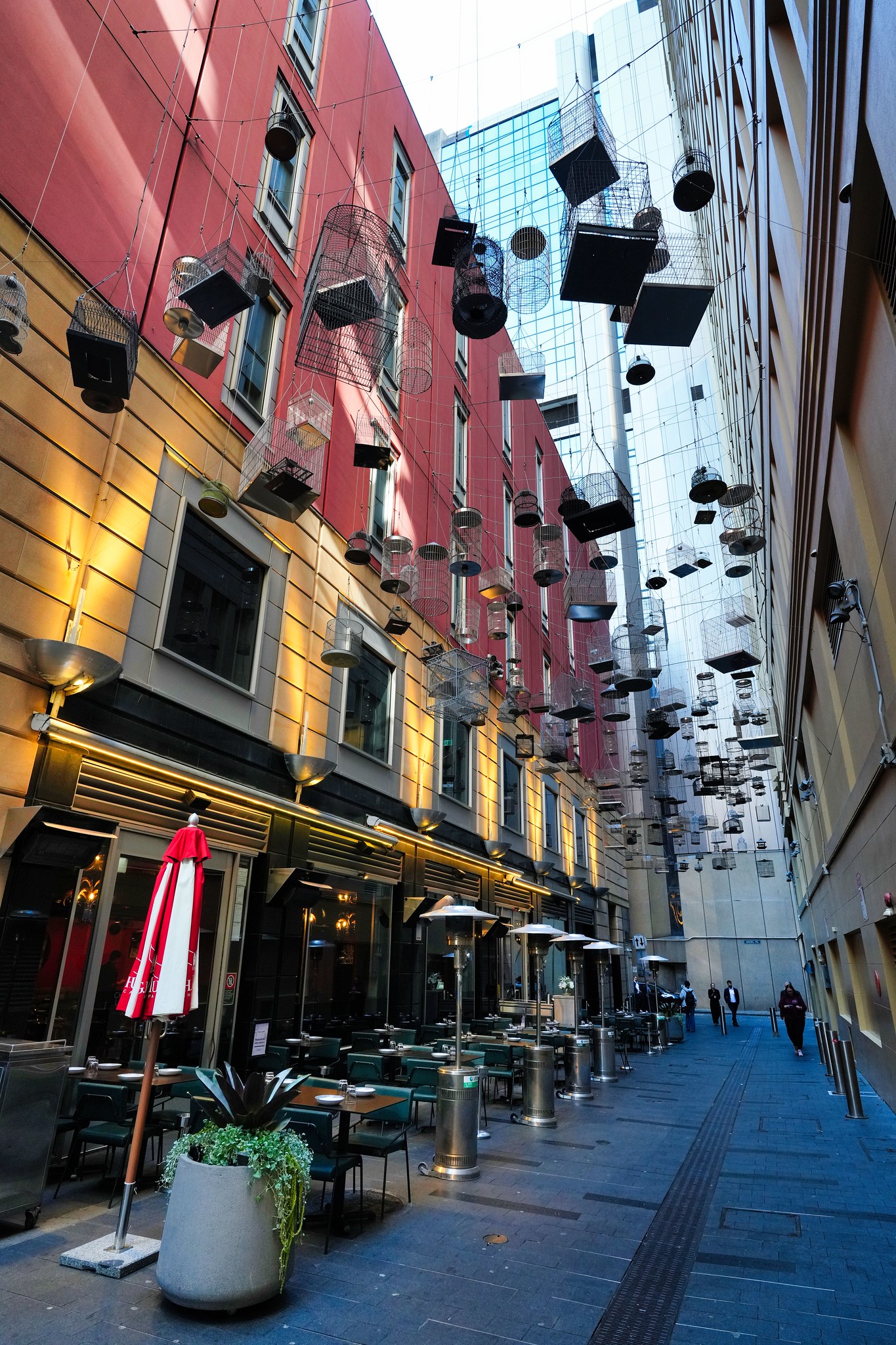
I paid a visit to Angel Place, a discreet and evocative laneway nestled near Martin Place in the heart of Sydney. My chief desire was to behold the suspended birdcages that grace the alleyway—a haunting and poetic installation known as Forgotten Songs. Conceived by artist Michael Thomas Hill and first installed in 2009 as part of the City of Sydney’s Laneways revitalisation program, this artwork commemorates the songs of fifty bird species once heard in the city before urbanisation drove them away. The empty cages, hanging above the narrow lane, evoke both memory and absence, as recordings of birdsong filter gently through the space, varying between day and night to reflect the natural calls of diurnal and nocturnal species. The experience was as moving as it was visually arresting—a poignant tribute to lost nature amidst the city's towering architecture.


Sony A7RV

FE 20-70mm f4 G

Linking Treasure Tuesday


Tuesday, June 17, 2025

Sydney Lunar Park at night for Treasure Tuesday


I have visited Sydney on numerous occasions, as is common for many Australians. My travels to the city have largely been for professional purposes, primarily attending conferences. In earlier years, I would often confine myself to the sterile interiors of hotel rooms, sustaining myself on provisions purchased from nearby supermarkets, venturing little into the urban sprawl beyond.

However, my perspective on cities such as Sydney and Melbourne—so often dismissed as soulless concrete jungles—began to shift a few years ago. I came to appreciate them not merely as landscapes of steel and stone, but as living theatres of culture. I developed a fondness for photographing their architecture, their people, and the fleeting moments that give life to the metropolis.

On a recent visit during the Vivid Sydney festival, I made a point to attend Luna Park—an iconic amusement park that dates back to 1935, nestled at the foot of the Sydney Harbour Bridge. This historic park, with its whimsical Art Deco facade and famous smiling face entrance, has long been a fixture of Sydney’s shoreline. Though it had often been closed during my previous visits, its gates were open on weekend evenings for the duration of the festival. Encouraged by the opportunity, I purchased my ticket in advance and resolved to explore its grounds.

Regrettably, my experience at the entrance was far from pleasant. The staff tasked with managing entry proved disorganised, and their conduct was discourteous and inattentive. The queue stretched the entire length of the wharf, winding beside the harbour. Upon finally entering the park, I found myself captivated not by the amusements, but by the sight of young performers dressed in resplendent carnival fashion—evocative of an era I have only seen through the lens of old cinema. There was a glamour to their attire that delighted me as a photographer and observer of human expression.

I chose to forgo the rides, many of which appeared both uninspiring and, frankly, of questionable safety. However, my visit took an unfortunate turn when I was abruptly approached by security personnel demanding a wrist identification band—an item I had not received at the gate, despite possessing a valid ticket with barcode. Their accusatory tone and my subsequent escort to the front gate to rectify the error left me feeling humiliated and unjustly treated. It was a sobering reminder of how poorly systems of order and hospitality can sometimes serve paying guests.

Despite this, a moment of joy emerged as I passed through a corridor ominously referred to as the "clown lane." The clowns—grotesque in design, with a macabre charm—might have unsettled others, but I found the absurdity delightful. I laughed aloud as I snapped photographs, grateful for having brought my 14mm f/1.8 lens, which allowed me to capture vivid images even in low light.

Joel, for his part, does not share my enthusiasm for such spectacles (he decided not to come from Melbourne), and so I ventured to Luna Park alone. In hindsight, while the experience was marred by poor management, it nonetheless offered a glimpse into the layered strangeness and splendour of Sydney’s cultural life—a city more nuanced than its concrete shell might suggest.


Sony A7RV

FE 14mm f1.8 GM

Linking Treasure Tuesday


Tuesday, May 6, 2025

Melbourne South Bank at night for Treasure Tuesday


It has been several years since my last visit to South Bank. I was pleased to discover a newly erected Ferris wheel, accompanied by a series of luminous installations that greatly appeal to photography enthusiasts. Of particular note is the splendid illumination of the surrounding architecture, which lends the precinct an enchanting ambiance after dusk and offers ample opportunity for artistic expression.

South Bank, situated along the southern banks of the Yarra River in Melbourne, is one of the city’s most vibrant cultural and recreational precincts. Once an industrial area, it has undergone a remarkable transformation into a bustling hub of art, dining, and entertainment. The promenade is lined with world-class restaurants, lively cafés, and luxury hotels, drawing both locals and visitors who seek to experience Melbourne’s cosmopolitan charm. Notably, the Arts Centre Melbourne and the National Gallery of Victoria, both iconic institutions, contribute to the area’s reputation as a cultural heart of the city.

In recent years, South Bank has seen the addition of new attractions, further enhancing its appeal. A striking Ferris wheel now graces the skyline, offering panoramic views of Melbourne and the Yarra River. At night, the precinct comes alive with a symphony of light—installations and architectural lighting casting a glow upon the buildings and walkways, creating a picturesque setting ideal for evening strolls and photographic pursuits. The thoughtful illumination of structures such as the Eureka Tower and surrounding facades adds an elegant brilliance to the cityscape, reflecting beautifully on the river’s surface.

South Bank is more than a destination; it is an experience that seamlessly blends the arts, leisure, and modern urban design. Its well-maintained promenades, proximity to the Central Business District, and integration of natural and man-made beauty make it a cornerstone of Melbourne’s identity. Whether one visits to enjoy a theatrical performance, dine by the river, or capture the interplay of light and architecture through a camera lens, South Bank offers a timeless and ever-evolving canvas that embodies the spirit of Melbourne.

Sony A7RV

FE 20-70mm f4 G

Linking Treasure Tuesday


Wednesday, January 21, 2026

Little Flinders Lane sign for Sign2


A rustic sign such as this impresses precisely because of what it says and how little it needs to say. Sprinkler stop valve inside. The words are plain, functional, and unadorned, yet they carry the quiet authority of purpose. There is no invitation here, no flourish—only instruction, rendered permanent by material and time.

Set along Little Flinders Lane, the sign belongs to the working grammar of the city. It speaks from an era when buildings were designed to be understood by those who maintained them, when safety and utility were marked clearly and left to do their work without spectacle. Its weathered surface bears the accumulated patience of years, the grain and fading evidence of a life spent outdoors, watching the lane change around it.

There is a classical restraint in such honesty. The sign does not pretend to be art, yet it achieves a kind of unintended poetry through endurance. In a city now saturated with curated surfaces and clever interventions, this simple notice remains grounded, a reminder that Melbourne was once built from instructions as much as ambitions.

“Sprinkler stop valve inside” reads almost like a quiet aside to the initiated—a message meant for hands rather than eyes, for responsibility rather than admiration. And yet it draws attention precisely because it has survived. In the narrow light of Little Flinders Lane, it stands as a modest relic of civic care, where even the most utilitarian object was made to last, and in lasting, acquired grace.


Sony A7RV

FE 16mm f1,8 GM


Linking Sign2


2026 lamb commercial made me laugh again 


Saturday, December 6, 2025

Butterfly for Saturday Critter


The scene glows with a quiet, luminous warmth—the kind of yellow that doesn’t shout but settles, like a secret whispered by sunlight. In the Melbourne Botanical Garden, colour never arrives alone; it drifts in with the breeze, pools at the base of old trees, lingers on petals as though reluctant to move on. But this shade of yellow feels deliberate, almost sculpted by the softness of the afternoon.

It is a colour that seems to hold its own weather: gentle, honey-warm, a counterpoint to the unpredictable moods of the city beyond the gates. It brightens the air without force, casting a mellow radiance along the winding paths and over the rippling lawns. You can feel it filling the space between leaves, turning shadows tender rather than sharp, as though the garden itself is taking a long, unhurried breath.

Nearby, the lake mirrors this gold—broken by the glide of a bird, a passing breeze, or the dip of a willow branch. The trees, old and knowing, seem to lean into the glow as if recalling seasons when the world felt slower. Even the faint hum of city life fades under this yellow hush, softened into something that feels almost musical.

Here, in this light, time loosens. Colours deepen. The ordinary becomes luminous.
It is the kind of yellow that lifts the heart without asking, the kind that finds you rather than the other way around—quiet, steady, and full of its own gentle grace.


Olympus E520 

150mm f2 


Linking Saturday Critter


Saturday, December 20, 2025

Mount Dandenong Wallaby for Saturday Critter


Among the weeds and soft, ungoverned grasses of Mount Dandenong, a wallaby paused—small enough to seem newly arrived in the world, its movements tentative, its attention alert. The young animal stood half-concealed by green growth, as though the mountain itself were teaching it how to remain unseen. There was something quietly disarming in the sight: a reminder that, even here, life continues on its own careful terms.

Mount Dandenong has long drawn people upward from Melbourne, away from the ordered grid of the city and into cooler air and taller trees. Tourists arrive for the forest drives, the lookouts, the gardens arranged with deliberate beauty, and the promise of escape contained within an easy distance. Cafés line the ridges, and cars pull over for views that frame the city far below, softened by haze. It is a place marketed for its charm and calm, its sense of elevation—both literal and emotional.

Yet encounters like this wallaby quietly resist the polished narrative of tourism. Beyond the paths and signposts, the mountain remains a working landscape of lives largely unnoticed. The grasses and weeds shelter creatures who do not pose for photographs, who move through the margins left between roads and picnic grounds. The presence of a young wallaby, still learning its place, gives the area a deeper texture: not just a destination, but a shared ground where human curiosity and older, ongoing patterns of life intersect.

In Mount Dandenong, tourism may set the stage, but moments like this supply the meaning. The mountain offers more than views and refreshment; it offers brief, unguarded glimpses into a continuity that predates and outlasts every visit.


Olympus E520

150mm f2


Linking Saturday Critter


Sunday, October 12, 2025

Spencer St urbanscape Melbourne for Sunday Best


I have previously featured this striking staircase, though not in full detail. Recently, I noticed a resurgence of interest in it across various media outlets, prompting me to revisit my archives and showcase these images once more.

This elegant spiral staircase is located on Spencer Street in Melbourne, within the precinct of the Southern Cross Station redevelopment area. Designed as part of Melbourne’s wave of contemporary architectural renewal in the early twenty-first century, it exemplifies the city’s commitment to blending form with function. The structure’s sinuous curve and contrasting textures—smooth white surfaces against the warmth of timber and the industrial coolness of steel—embody the modernist dialogue between art and engineering.

Despite its architectural merit, the staircase has long drawn both admiration and controversy. Many photographers have been captivated by its sculptural beauty, though the building’s security personnel were often less enthusiastic—reportedly instructing photographers in no uncertain terms to leave the premises. Yet, as with much of Melbourne’s modern design, its appeal endures, quietly asserting itself as an icon of the city’s evolving urban landscape.


Sony A7RV

Laowa 9mm f5.6 


Linking Sunday Best


Sunday, April 20, 2025

Brisbane Night Ferris Wheel Long Exposure for Sunday Best


To undertake the task of long exposure photography amidst the throngs of Brisbane’s bustling South Bank is to court both patience and fortune. The city, vibrant and unceasing in its rhythm, seldom affords the stillness such a technique demands. Yet there, among the restless footsteps and the murmur of daily life, stands a quiet marvel — the Wheel of Brisbane — solemn, grand, and ever-turning.

Erected in 2008 to commemorate the sesquicentennial of Queensland, the Ferris wheel is no mere amusement; it is a modern monument, a gentle giant by the river’s edge, offering sweeping views and enduring symbolism. It revolves steadily, indifferent to the ceaseless passage of pedestrians below, many of whom scarcely glance upward. It is, in its way, a keeper of time — not by ticking hands, but by its own slow revolution.

To photograph such a subject using long exposure is to attempt an act of reverence. The camera, when held in stillness with the shutter drawn open, does not simply record an image — it collects time itself. Light weaves its threads across the frame, motion becomes memory, and all that is unmoving grows luminous and sharp.

Yet therein lies the challenge: the constancy of human movement. Strangers wander unbidden into the composition, their forms becoming translucent echoes — smudges of presence that both enrich and disrupt the clarity of the scene. The Wheel, by contrast, remains serene — turning, yes, but in such a measured fashion that it may appear suspended in time if one is patient and precise.

There is, in this pursuit, a certain poetry. As I adjusted my lens and steadied my breath, I began to perceive the act not merely as photography, but as a conversation between permanence and transience. The Ferris wheel — emblem of modern celebration, built upon a foundation of history — stood as the anchor. Around it, the city’s people flowed like a living river.

And in one fortunate moment — a moment gifted more by grace than by skill — the exposure yielded a quiet revelation. The wheel shone, sharp and majestic, while the crowd had melted into gentle motion, like ghosts in passing. Time, for an instant, had folded, and Brisbane had revealed its dual nature: ever-changing, yet ever the same.

Such is the beauty of capturing the ephemeral. The camera does not merely steal a moment — it elevates it. And in the luminous whirl of Brisbane’s Ferris wheel, we glimpse not only the present, but the echo of what has been and the promise of what may come.

Sony A7RV

Laowa 9mm f5.6

Linking Sunday Best


Tuesday, July 22, 2025

West Gate Park Melbourne for Treasure Tuesday


We had initially set our sights on Sandridge Bridge, intending to capture the city skyline at sunset. Much to our surprise and disappointment, the entire area had been cordoned off, denying us access. Undeterred, we sought an alternative vantage point that might render the excursion worthwhile. We turned our course towards Westgate Park, only to discover that it too was undergoing extensive construction works—an added frustration.

Nonetheless, perseverance led us to a suitable spot from which to photograph the twilight. The gentle hues of dusk, softened by the encroaching night, provided some consolation.

Westgate Park itself, situated along the banks of the Yarra River beneath the West Gate Bridge, has long served as a haven for birdlife and city dwellers alike. Once a barren expanse of industrial wasteland, it was transformed during the 1980s as part of Melbourne’s urban greening initiatives. The park is especially known for its striking pink lake—a seasonal natural phenomenon caused by the proliferation of salt-loving algae under specific climatic conditions.

The current redevelopment seeks to enhance visitor access, restore native habitats, and improve ecological sustainability. Though temporarily inaccessible, it promises to return as an even more vibrant urban refuge.

Our evening concluded at a nearby Japanese restaurant, where we sought comfort in freshly pan-fried gyoza. Joel, in high spirits, treated himself to a small carafe of sake—rounding off a day that, though unplanned in its course, retained its moments of charm and reward.

Sony A7RV

FE 20-70mm f4 G


Linking Treasure Tuesday


Monday, June 16, 2025

Chippendale Murals in Sydney for Mural Monday


Whilst in Sydney, I set myself the quiet task of wandering from suburb to suburb in search of mural art. I made no attempt to hire a motorcar, nor did I feel drawn to the coastlines or national parks; rather, I devoted myself to the intricacies of the city’s urban sprawl, traversing it solely on foot. Yet the endeavour proved less rewarding than I had hoped. The streets of Sydney, for all their breadth and bustle, yielded few treasures compared to the vibrant abundance of murals that grace Melbourne’s laneways.

The first piece I encountered was by Adnan—an artist of considerable renown, whose work carries the weight of legend. But beyond that, the city’s walls had largely been marred by careless tags, their original images so disfigured that one could scarcely make out what once lay beneath. Still, there was a strange solace to be found in Chippendale, a suburb now softened by gentrification. Among its quiet decay, I captured with my lens the solemn beauty of forsaken buildings—forgotten places, imbued with a melancholy charm all their own.

Sony A7RV

FE 20-70mm f4 G

Linking Mural Monday


Monday, June 13, 2011

A walk in the city on Queen's birthday day

Photos would speak for themselves I think...


This building was recently made at Federation Square in the name of Earth hour... It looked sooo ugly that I doubt it was that environmentally friendly...


Here we go!


Looks very energy efficent by drawing some artificial lighting.


Now lets celebrate earth hour by using more electricity !!!!


So many people cared about earth hour... errrr...


If you are blinded by eye patches, sure you dont need electricity!


This is how I celebrate my earth hour lol


Yes, cooking is more fun using gas instead of electricity. Green house effect is a good distraction for us.


This guy supposed to teach us how to use the funnel and flask to distill coffee ... It turns out some chemical reactions undesirable!


Yeah, C grade class event today in city.


Mmmm I love coffee...


Little Collins St


Lets drink some soup.


Portugese chicken soup - A little too normal...


Smoked bacon pea and zuccini soup


Cafe life is very relaxing...


Long lasting melody


The end